


Business Continuity Planning
If someone asked us a year ago about the importance of being prepared for a crisis, we probably would have seen it to be important, but not necessarily urgent.
The bushfires at the start of the year followed by the COVID-19 has taught us otherwise.
Whether you operate a small or medium sized business or a large corporation, you strive to remain competitive and retain current customers while increasing your customer base and now is the time to test your capability of surviving in uncertain times right and ceasing opportunities that the pandemic presents.
Business Continuity Planning (BCP) is “the process of ensuring that your critical business functions are prepared to react to and recover from a business disruption with minimal amount of impact to your business”.
In the big scheme of things, the relatively small investment in business continuity planning is one of the best investments you can make in your business, your reputation, and your livelihood.
Best of all you will have identified processes and systems that have worked for you well over the past few months as you have made changes significant changes to your operations.
My recommendation is to capitalise on what you have learned and built on this as this will give you have a head-start on dealing with the next crisis and recover more quickly.
BCP is a comprehensive collaborative approach and it is made up of various plans that fit together like building blocks. It involves developing a practical plan with everyone in the business to protect your staff and business assets. We shouldn’t underestimate the value of the peace of mind such planning creates. While it is impossible to predict every kind of incident that may threaten your business, it is possible to develop a basic plan to cover a range of crisis events.
The Australian Government encourages businesses to use The PPPR model: Prevention, Preparedness, Response and Recovery (PPRR) model.
The objectives of a BCP can be broken down into the following components:
- undertake risk management assessment
- define and prioritise your critical business functions
- detail your immediate response to a critical incident
- detail strategies and actions to be taken to enable you to stay in business
- review and update this plan on a regular basis.
First step is Prevention
This step identifies and manages the likelihood and/or effects of risk associated with an incident. This involves identifying the risks that could impact your business and choosing the best ways of dealing with each. If you already have a risk management plan, you may just look at refreshing and broaden this
Second step is Preparedness
A business impact analysis identifies the activities in your business operations that are key to its survival, using the information in your Risk Management Plan to assess the identified risks.
During the process you will
- define and describe your critical business activities
- describe the potential losses if these business activities could not be provided
- rate importance of the activities on a scale of 1 to 5 and establish how long each business activity be unavailable for
- evaluate whether these activities depend on any outside services or products
Response
The risk management plan and business impact analysis help you to formulate your incident response plan.
It should include:
- Plan activation details, including a clear statement of the circumstances when the plan will be activated and who is authorised to do so
- Incident response team details, including key roles and responsibilities
- An emergency kit
- List of employees with contact details – include home and mobile numbers, and even e-mail addresses. You may also wish to include next-of-kin contact details.
- Lists of customer and supplier details.
- Evacuation procedures for your premises
- A communication plan, including key communication methods and timings needed to keep everyone safe
- Contact lists for all the people you will need to communicate with during a crisis, including staff and emergency services, insurances, security, gas, electricity etc.
- An event log to record information, decisions and actions that you take during a crisis.
Recovery
Developing strategies to recover your business activities in the quickest possible time.
It involves:
- identifying resources required to recover your operations
- documenting your previously identified recovery time objectives
- listing the person/s who have responsibility for each task and the expected completion date.
How do you build a recovery plan for your company if you don’t have certainty about the future? That’s like laying the foundations of your house on a ground that might move or shift in the future. We all agree that decision making should be based more on data and analysis than intuition and gut feelings. But there are two problems here: First, data may be difficult to gather. Second, data tells you about the past but gives you absolutely no indication about the future.
A good way of approaching the recovery plan is using a tool from strategic management called scenario planning. What is scenario planning?
- Scenario planning is making assumptions on what the future is going to be and how your business environment will change overtime in light of that future.
- More precisely, scenario planning is identifying a specific set of uncertainties, different “realities” of what might happen in the future of your business.
- It sounds simple, and possibly not worth the trouble or specific effort, however, building this set of assumptions is probably the best thing you can ever do to help guide your organization in the long term.
I have personally found this table from a Forbes Article by Stephen Wunker a good though provoker as to what you need to consider for your recovery plan. 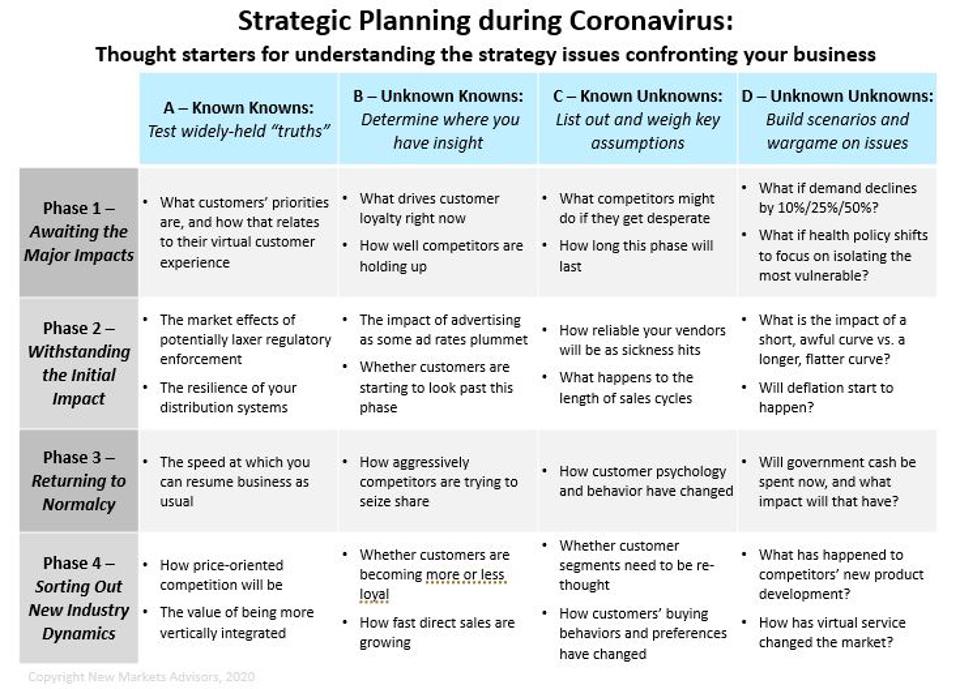
https://www.forbes.com/sites/stephenwunker/2020/03/23/business-strategy-through-four-phases-of-the-coronavirus-crisis/#6008d6cc13ae
Horizontally it explores….
- Know Knowns: Test widely held truth
- Unknown Knows: Determine where you have insight
- Known Unknows: List out and weigh assumptions
- Build scenarios and wargame on issues
Vertically it captures….
- Awaiting the major impacts
- Withstanding the initial impact
- Returning to normalcy
- Sorting out new industry dynamics
The best way to navigate an uncertain future is to be open, get curious and be committed to learning and having a growth mindset.
We often here the buzzword being agile or doing agile. An agile culture can be simplified into four imperatives: collaborate, deliver, reflect, and improve, nothing more.
- Collaboration within and outside the business is increasingly important;
- Engaging employees, partners, suppliers, customers can increase creativity, productivity, and help attract and keep great talent;
- No amount of analysis will allow us to predict the future. We must learn by doing;
- Seek out opportunities to learn from your own successes and from failures and those of others
You’ve worked hard to build up your business, your reputation and your livelihood. So, in the big scheme of things, the relatively small investment in business continuity planning is one of the best investments you can make in your business.
I congratulate you for being on this learning journey…